Today marks the launch of Can't Understand New Technology - an insider newspaper reporting on what Silicon Roundabout really
thinks about new technology. Twenty-five contributions from some of London's leading creatives and strategic thinkers weigh on how technology is affecting our industry and the way we all work, think and live.
Can't Understand New Technology references the now-infamous Shoreditch Twat and the satirical Private Eye - aiming to give a platform to the people who really can understand new technology: People who realise the true potential of technology within creativity and meaningful communications; People who are relentlessly pushing their clients, their colleagues and themselves to seamlessly integrate technology into their processes and thinking; People who can understand the absurdity of the new, and yet know it is merely the norm of the future.
I - and my co-founder Steve Price - decided to use old technology to launch Can't Understand New Technology by creating a print-only publication with no online presence apart from that created by those who read it. You can follow their conversations by using the hashtag #cantunderstandnewtechnology across Twitter, Instagram and even Vine.
I look forward to seeing how Can't Understand New Technology is received, and reading the responses to the issues it raises. To be added to the distribution list for Issue 2, or if you'd like to speak to us about press, please contact me (@camillastore) or Steve (@planbstudio).
Meantime, I'd like to shout out and thank all those who got involved and made Can't Understand New Technology a publication I am bursting with pride to launch.
Anna Morley
Chris Grant
Dave Birss
Ed Robinson
Ellen Turnill Montoya
Flo Heiss
Glyn Britton
Graham Wood
Harry Woodrow
James Denman
Laura Jordan Bombach
Marc Lewis
Matthew Knight
Panja Gobel
Sam Ball
Simon Manchipp
Stephen Fulljames
Steve Price
Tom Kile Hartshorn
Tony Hymes
Tyler Finck
Vicky Kochowski
Paul West
Asi Sharabi
Anrick Bregman
Can't Understand New Technology launches today - because who wouldn't enjoy a #cantunderstandnewtechnology in the post on V-day?
Wednesday, February 13, 2013
Tuesday, January 29, 2013
The one about Vine
It may only be a few days old but Vine has become this week’s must-have, so hot-right-now app and brands should be taking note. A quick scoot around the Discover section showed up heaps of content tagged with - and about - brands. #Nike, #Burberry and #Starbucks already had quite a bit of user-generated content which, though small and inconsequential now, might have a larger impact on those brands in the long-term.
Though some brands were quick to jump on the latest bandwagon, it's the companies who take a moment to assess and define their role on the platform - and the people they want to connect with - that will ultimately strengthen their brands. These platforms take time to develop their own communities, vernacular and even eccentricities. For the time being, brands should just sit quietly and watch.
Regardless of whether Vine is the Instagram of videos/ the YouTube killer/ the Piction of Twitter/ the Path of 2013... it remains indisputable that short-form moving content is here to stay. Are the filmmakers amongst us soon to be getting briefs for 6 second brand films and branded content? Will I be writing guidelines for creating micro-trailers for ads? It’s a compelling thought and one which the world’s most talked about brands would do well to prepare for now.
Though some brands were quick to jump on the latest bandwagon, it's the companies who take a moment to assess and define their role on the platform - and the people they want to connect with - that will ultimately strengthen their brands. These platforms take time to develop their own communities, vernacular and even eccentricities. For the time being, brands should just sit quietly and watch.
Regardless of whether Vine is the Instagram of videos/ the YouTube killer/ the Piction of Twitter/ the Path of 2013... it remains indisputable that short-form moving content is here to stay. Are the filmmakers amongst us soon to be getting briefs for 6 second brand films and branded content? Will I be writing guidelines for creating micro-trailers for ads? It’s a compelling thought and one which the world’s most talked about brands would do well to prepare for now.
Friday, January 25, 2013
Do you remember the Internet?
Yesterday Microsoft launched a new campaign around their update to Internet Explorer, with a video entitled “Child of the 90’s”. The slightly micro-soft-touch video aimed to tug at our Gen Y heartstrings with memories of pogs, tamagotchi’s, slap bands and - you guessed it - “the browser you loved to hate”. To use a term coined by The Future Laboratory, “netstalgia” is in full force, as me and my contemporaries begin to fondly remember the good old days of dial-up broadband and phones the size of a Fiat Punto. For the perhaps the first time, it’s now possible to market web-based services with the rose-tint of nostalgia, rather than the blinding glint of innovation.
On a similar, if somewhat, tangential note, I’ve been thinking a lot lately about the internet on film. Whether it’s about retrospective storytelling (The Social Network, Jobs) or the web as a narrative device (HBO’s Girls will be my primary reference for this), filmmakers are facing an increasingly challenge of making screens, code and online activity as visually exciting as the real world action taking place in the story.
I am loathe to give Lena Dunham any more column inches, but her integration of the Internet within the plot and lives of her characters marks a watershed moment for film and TV. We can no longer pretend that online interactions aren’t contributing to the momentum of a contemporary storyline. I’m not talking “You’ve Got Mail”, where an occasional screen-shot of an email revealed the characters’ burgeoning relationship. Technology has made human interaction complex - a broad range of subtle cues from across a range of platforms now impact the trajectory of our lives.
But if people looking at screens is boring, do we have to invent a new cinematic style to literally show the deep subtext taking place in the virtual world? For some reason, I keep returning to this video.
It’s gaudy, it’s over the top, and it’s French.... but it kind of works. I may be part of a generation that gets “netstalgic” for when life took place on just a few platforms, when the protagonists we watched on TV had only to wait by the just one phone for her life to change. But, to the generations behind me, this kind of overt meta data, is an intrinsic part of their world view. And film and TV need to reflect that if they are going to continue to tell rich, meaningful stories about characters we believe in, love and remember forever.
On a similar, if somewhat, tangential note, I’ve been thinking a lot lately about the internet on film. Whether it’s about retrospective storytelling (The Social Network, Jobs) or the web as a narrative device (HBO’s Girls will be my primary reference for this), filmmakers are facing an increasingly challenge of making screens, code and online activity as visually exciting as the real world action taking place in the story.
I am loathe to give Lena Dunham any more column inches, but her integration of the Internet within the plot and lives of her characters marks a watershed moment for film and TV. We can no longer pretend that online interactions aren’t contributing to the momentum of a contemporary storyline. I’m not talking “You’ve Got Mail”, where an occasional screen-shot of an email revealed the characters’ burgeoning relationship. Technology has made human interaction complex - a broad range of subtle cues from across a range of platforms now impact the trajectory of our lives.
But if people looking at screens is boring, do we have to invent a new cinematic style to literally show the deep subtext taking place in the virtual world? For some reason, I keep returning to this video.
It’s gaudy, it’s over the top, and it’s French.... but it kind of works. I may be part of a generation that gets “netstalgic” for when life took place on just a few platforms, when the protagonists we watched on TV had only to wait by the just one phone for her life to change. But, to the generations behind me, this kind of overt meta data, is an intrinsic part of their world view. And film and TV need to reflect that if they are going to continue to tell rich, meaningful stories about characters we believe in, love and remember forever.
Labels:
behaviour,
film,
storytelling,
tv
Saturday, December 29, 2012
Weird customer experiences
Question: What is the line between awesome, personalised customer service and creepy, invasive behaviour from a brand?
Ok, so here’s what happened. A few days ago I stopped by the Rag + Bone store. Whilst there I tried on about five items and bought one. Claudine (name changed), the sales assistant, was friendly and helpful. Absolutely nothing about her approach or our interaction was out of the ordinary. At the till, she asked for my email address and - assuming I would be subscribed to the R+B newsletter - I gave it to her. Happy days.
Yesterday I got an email from Claudine. This is what it said,
Hi Camilla, I hope you had a lovely Christmas, I remember you bought the skirt, I was just wondering if you had a chance to wear it already? Have you got any plan for New year? If you need anything else, let me know, I'll be happy to serve you again. If I don't see you before, Happy New Year. xx
Now... is that weird? I really can’t decide. In my previous post I was strongly lamenting the lack of a tailored, personal, engaged conversation with a brand. Yet now I’ve been invited into one I feel a bit... off about it. Is this how Rag + Bone care for their customers? In which case, that’s a lot of effort for someone who bought a single sale item. Or has our Claudine accessed my personal details in order to make friends or even hit on me? I can’t work it out.
Either way, it comes across as customer service design and brand guidelines gone awry - like a collquialism put through Google Translate. Rag + Bone, if you’re reading, you might want to get a handle on this so I, and perhaps others, can enjoy their new clothes without the shadow of poor grammar and strange undertones. Meantime, I think I'll stick to sale shopping online!
Ok, so here’s what happened. A few days ago I stopped by the Rag + Bone store. Whilst there I tried on about five items and bought one. Claudine (name changed), the sales assistant, was friendly and helpful. Absolutely nothing about her approach or our interaction was out of the ordinary. At the till, she asked for my email address and - assuming I would be subscribed to the R+B newsletter - I gave it to her. Happy days.
Yesterday I got an email from Claudine. This is what it said,
Hi Camilla, I hope you had a lovely Christmas, I remember you bought the skirt, I was just wondering if you had a chance to wear it already? Have you got any plan for New year? If you need anything else, let me know, I'll be happy to serve you again. If I don't see you before, Happy New Year. xx
Now... is that weird? I really can’t decide. In my previous post I was strongly lamenting the lack of a tailored, personal, engaged conversation with a brand. Yet now I’ve been invited into one I feel a bit... off about it. Is this how Rag + Bone care for their customers? In which case, that’s a lot of effort for someone who bought a single sale item. Or has our Claudine accessed my personal details in order to make friends or even hit on me? I can’t work it out.
Either way, it comes across as customer service design and brand guidelines gone awry - like a collquialism put through Google Translate. Rag + Bone, if you’re reading, you might want to get a handle on this so I, and perhaps others, can enjoy their new clothes without the shadow of poor grammar and strange undertones. Meantime, I think I'll stick to sale shopping online!
Monday, December 10, 2012
Data and the new brand strategy
This is a long read, but there's quite a bit I want to cover. So please bear with me. I’m going to try and break it down, because this is important and I am keen to get feedback.
Last week I had a run in with Virgin Media. But that’s not what this post is about, so read on. Despite going to hell and back trying to rectify the situation, what emerged - phoenix like - from the burning embers of my belief in the Virgin brand, was a light bulb moment with regards to the future of brand strategy.
In short, my belief if this:
We, the branding industry, are ultimately failing our clients by omitting to tie their brand strategy to their data strategy
Business strategy + brand strategy = proof of process
Good brand strategy is intrinsically linked to a client’s business objectives. They’re generally what drives the brief in the first place, and they act as one of the few measurable proof points for what branding can achieve. This approach still stands. It is important to note, however, that increasingly those business objectives have come to include terms like “user engagement” and “digital leaders in our industry”.
The new brand strategy
In the past few years, what a brand is, what it stands for, how it is accessed and how it is expected to behave have fundamentally changed. With the rise and rise of social media and technology in general, the number of brand touchpoints has grown limitless. A brand now needs to be consistently recognisable, whether it’s on the homepage of their website or on their regionalised Instagram feed.
In response, agencies have had to learn how to bring in people with new skillsets, usually with the word “digital” in front of their title. For some companies, this has meant recruiting, for others it’s meant buying/merging with digital agencies. As a result, agency offerings now include things like UX/UI, bespoke app creation and social media guidelines. This is a good thing.
Brand strategy - Data strategy = unhappy customers
Unfortunately, as we’ve become experts in “thinking outside the box” and “pushing boundaries”, and got busy making all the assets that go along with it, we’ve forgotten one crucial thing. We forgot to explain to our clients what to do with all the data these digital touchpoints create. Yes, we may have told them how valuable the data is, and what amazing insights it can give them. But we’re not really helping them go beyond that. It’s like we’ve delivered the big screen tv, and have left them to sort out the wiring. This needs to change fast.
Case study: Virgin Media
Virgin - one of the world’s largest and best known brands. I trust them. I was more than happy to go with them for my broadband. When I hit a problem, however, it quickly became apparent that their social media team was entirely silo-ed from their customer service team who - in turn - were silo-ed from their technicians on the ground. My conversations with Virgin Media on Twitter were not reflected in my conversations with them on the phone. Meaning, that while they had the Twitter account, and the tone of voice guidelines, and the staff, they were unable to identify me as a customer and pass my concerns on to someone who could actually help. Their information flow was failing to match consumer expectations, or to put it another way, they had the TV and had not plugged it in.
Lots of information = big data
The experience I had with Virgin Media was mainly due to one piece of information failing to be passed through to the correct channels. But my issue can’t possibly have been unique to me, Virgin Media must deal with thousands of similar issues on a daily basis. And lots of similar information is known as “data”. If a company as big as Virgin have a data disconnect that's this visible and this damaging to their brand, what others do they have hiding beneath the surface? If they’re not looking at their data, and mixing it up with other data from other departments like, for example, their technical team, then they are running an inefficient business. Business, brand, data - it all works together.
The Solution
1. As brands increasingly express themselves and come to life through technology, so they generate vast amounts of real-time qualitative and quantitative data that is valuable to every part of the business.
2. The branding industry need to work with data scientists if they are to offer the most impactful digital solutions for their clients. The two skill sets can no longer thrive in isolation.
3. It is the responsibility of the branding industry to clearly identify what data each of their recommended touchpoints creates, and how that data should be gathered, managed, processed, interpreted and acted upon by the entire organisation.
4. Moving forward, a data strategy should act as the glue between the business objectives and the brand strategy.
So there we have it. Thoughts? Is it possible? Is it crazy? Or might it just be the future? Let me know.
Last week I had a run in with Virgin Media. But that’s not what this post is about, so read on. Despite going to hell and back trying to rectify the situation, what emerged - phoenix like - from the burning embers of my belief in the Virgin brand, was a light bulb moment with regards to the future of brand strategy.
In short, my belief if this:
We, the branding industry, are ultimately failing our clients by omitting to tie their brand strategy to their data strategy
Business strategy + brand strategy = proof of process
Good brand strategy is intrinsically linked to a client’s business objectives. They’re generally what drives the brief in the first place, and they act as one of the few measurable proof points for what branding can achieve. This approach still stands. It is important to note, however, that increasingly those business objectives have come to include terms like “user engagement” and “digital leaders in our industry”.
The new brand strategy
In the past few years, what a brand is, what it stands for, how it is accessed and how it is expected to behave have fundamentally changed. With the rise and rise of social media and technology in general, the number of brand touchpoints has grown limitless. A brand now needs to be consistently recognisable, whether it’s on the homepage of their website or on their regionalised Instagram feed.
In response, agencies have had to learn how to bring in people with new skillsets, usually with the word “digital” in front of their title. For some companies, this has meant recruiting, for others it’s meant buying/merging with digital agencies. As a result, agency offerings now include things like UX/UI, bespoke app creation and social media guidelines. This is a good thing.
Brand strategy - Data strategy = unhappy customers
Unfortunately, as we’ve become experts in “thinking outside the box” and “pushing boundaries”, and got busy making all the assets that go along with it, we’ve forgotten one crucial thing. We forgot to explain to our clients what to do with all the data these digital touchpoints create. Yes, we may have told them how valuable the data is, and what amazing insights it can give them. But we’re not really helping them go beyond that. It’s like we’ve delivered the big screen tv, and have left them to sort out the wiring. This needs to change fast.
Case study: Virgin Media
Virgin - one of the world’s largest and best known brands. I trust them. I was more than happy to go with them for my broadband. When I hit a problem, however, it quickly became apparent that their social media team was entirely silo-ed from their customer service team who - in turn - were silo-ed from their technicians on the ground. My conversations with Virgin Media on Twitter were not reflected in my conversations with them on the phone. Meaning, that while they had the Twitter account, and the tone of voice guidelines, and the staff, they were unable to identify me as a customer and pass my concerns on to someone who could actually help. Their information flow was failing to match consumer expectations, or to put it another way, they had the TV and had not plugged it in.
Lots of information = big data
The experience I had with Virgin Media was mainly due to one piece of information failing to be passed through to the correct channels. But my issue can’t possibly have been unique to me, Virgin Media must deal with thousands of similar issues on a daily basis. And lots of similar information is known as “data”. If a company as big as Virgin have a data disconnect that's this visible and this damaging to their brand, what others do they have hiding beneath the surface? If they’re not looking at their data, and mixing it up with other data from other departments like, for example, their technical team, then they are running an inefficient business. Business, brand, data - it all works together.
The Solution
1. As brands increasingly express themselves and come to life through technology, so they generate vast amounts of real-time qualitative and quantitative data that is valuable to every part of the business.
2. The branding industry need to work with data scientists if they are to offer the most impactful digital solutions for their clients. The two skill sets can no longer thrive in isolation.
3. It is the responsibility of the branding industry to clearly identify what data each of their recommended touchpoints creates, and how that data should be gathered, managed, processed, interpreted and acted upon by the entire organisation.
4. Moving forward, a data strategy should act as the glue between the business objectives and the brand strategy.
So there we have it. Thoughts? Is it possible? Is it crazy? Or might it just be the future? Let me know.
Labels:
bigdata,
brands,
data,
digital strategy,
strategy
Wednesday, November 14, 2012
Pinterest secrets
Pinterest may be the “ladies” social networking site, but a Business Insider article from last February highlighted Pinterest’s growing problem with porn. BI pointed out that for Pinterest to generate ad revenue, it would have to “Find a way to crack down on the naked flesh and get back to fashion and recipes”. So, let’s get real here, Pinterest. Your new “secret boards” addition isn’t about “keeping track of holiday gifts, planning a special event, or working on a project you aren’t yet ready to share with the rest of the world”, it’s about giving all the naked, tattooed hipster chicks a place to roam free.
Regardless of intention, however, I find the release of “secret boards” a fascinating new string to Pinterest’s bow. Similarly, Twitter’s direct messaging facility - a known loss-maker for the platform - remains a key draw for its users. As Grace Dent wrote in ‘How to leave Twitter’, “...if one morning everyone’s direct message box was suddenly, accidentally posted in the public timeline there would be rioting in international cities by lunchtime. Most of this would be warring couples chucking bin-bags of clothes at each other”. Ultimately, while we all love to share and chat and banter, we also need the Internet equivalent of that dark corner of the pub in which to get up to no good.
Pinterest’s naughty corner is “secret boards”. As they say, you can “keep your secret boards to yourself or invite friends to pin with you”. Cheeky. In all seriousness, though, genuine privacy and real secrets are some of the few things a digital life cannot offer in the way our offline lives can. Online, we operate on the cusp of becoming victims of our own propensity to connect and share. Out there on the interwebs we are always just one wrong click away from the judgement of the government, international corporations, and, ultimately, our own nearest and dearest. We live in the age of the screenshot and seamless sync, where no indiscretion can ever truly be hidden, forgotten or flatly denied. Just ask the Generals Petraeus and Allen.
Whatever their motives, “secret boards” mark an interesting step not just for Pinterest but for the direction of social networking platforms as a whole. Human instinct for keeping secrets puts the likes of Twitter, Facebook and Pinterest between a rock and hard place. Do they cater to the private desires of their users by providing the digital dark corners in which to be naughty, or do they insist on purely public platforms in order to be nice to the money men?
However well these platforms strike a balance between their user needs and business needs, the responsibility for our behaviour remains our own. A direct message only allows for 140 characters. But a pin can say a thousand words. Whether we use them to be naughty or nice is down to us.
Regardless of intention, however, I find the release of “secret boards” a fascinating new string to Pinterest’s bow. Similarly, Twitter’s direct messaging facility - a known loss-maker for the platform - remains a key draw for its users. As Grace Dent wrote in ‘How to leave Twitter’, “...if one morning everyone’s direct message box was suddenly, accidentally posted in the public timeline there would be rioting in international cities by lunchtime. Most of this would be warring couples chucking bin-bags of clothes at each other”. Ultimately, while we all love to share and chat and banter, we also need the Internet equivalent of that dark corner of the pub in which to get up to no good.
Pinterest’s naughty corner is “secret boards”. As they say, you can “keep your secret boards to yourself or invite friends to pin with you”. Cheeky. In all seriousness, though, genuine privacy and real secrets are some of the few things a digital life cannot offer in the way our offline lives can. Online, we operate on the cusp of becoming victims of our own propensity to connect and share. Out there on the interwebs we are always just one wrong click away from the judgement of the government, international corporations, and, ultimately, our own nearest and dearest. We live in the age of the screenshot and seamless sync, where no indiscretion can ever truly be hidden, forgotten or flatly denied. Just ask the Generals Petraeus and Allen.
Whatever their motives, “secret boards” mark an interesting step not just for Pinterest but for the direction of social networking platforms as a whole. Human instinct for keeping secrets puts the likes of Twitter, Facebook and Pinterest between a rock and hard place. Do they cater to the private desires of their users by providing the digital dark corners in which to be naughty, or do they insist on purely public platforms in order to be nice to the money men?
However well these platforms strike a balance between their user needs and business needs, the responsibility for our behaviour remains our own. A direct message only allows for 140 characters. But a pin can say a thousand words. Whether we use them to be naughty or nice is down to us.
Saturday, October 27, 2012
Say you want a revolution
I went to two talks this week. Both on similar subjects yet both very different in attitude and approach. The first was The Frontline’s talk on Cyber Snooping in partnership with BBC Arabic. The panel was well put together; consisting of a varied mix of people working at the forefront of technological and online governance in a range of capacities. Though proceedings occasionally took a turn for the paranoid, the general sentiment was that it was time to get real about the definition, legislation and regulation of online activity for individuals, corporations and governments on a global scale.
In contrast, D&AD’s “Digital Revolution 2.0” event was, with a few minor exceptions, as worryingly backward as the title itself. Not only did I find myself wondering if 2.0 was just a way to make the proceedings feel more “Internet-y”, but, with references to Second Life and Star Trek, whether I had also somehow travelled back in time to 2004. Assuming, for a moment, that I had, then the event was right on the money. In the early noughties, technology had almost divested itself of its geeks-only image and started to go mainstream. The line between online and offline began to blur, and everyday life was changing dramatically as a consequence. It felt wondrous, magical and overwhelming. In 2004 we had no idea how it was all going to pan out or, to paraphrase Neville Brody in Wednesday’s opening remarks, how we as people might potentially interface and interact.
If I had been asked to present on Wednesday, which is unlikely since D&AD evidently find it unthinkable to have more than two women in a panel of six, I would have pointed out that this is 2012 and the Revolution has been and gone. Wikipedia (yes, no longer do I refer to my twelve volume encyclopedia) defines a post-Revolutionary state as one that has resulted in major changes in culture, economy and socio-political institutions. Could you argue that “Digital” has contributed to fundamental change in those areas already? Yes.
The Digital Revolution (let’s just drop the 2.0 shall we?) not only changed institutions, it instigated new ones. The human experience expanded from one existing entirely in the physical world, to one that now incorporates an ever-evolving online world. So much so that people like Birgitta Jónsdóttir, a panelist at the Frontline Club’s event, are not only championing civil rights in the context of the twenty-first century but actively pioneering things like a global freedom of information act and international codes of conduct.
D&AD stands to represent the global design, creative and advertising industries. In this privileged capacity, they ought not to be pontificating on “what it all means”. Getting up on stage and throwing around words like “instagram”, “fluid data” and “re-Renaissance” just add to the noise. Like their political counterparts, D&AD have a responsibility to leverage their name and their expertise to design the direction of digital culture in our changed, and still changing, world.
In contrast, D&AD’s “Digital Revolution 2.0” event was, with a few minor exceptions, as worryingly backward as the title itself. Not only did I find myself wondering if 2.0 was just a way to make the proceedings feel more “Internet-y”, but, with references to Second Life and Star Trek, whether I had also somehow travelled back in time to 2004. Assuming, for a moment, that I had, then the event was right on the money. In the early noughties, technology had almost divested itself of its geeks-only image and started to go mainstream. The line between online and offline began to blur, and everyday life was changing dramatically as a consequence. It felt wondrous, magical and overwhelming. In 2004 we had no idea how it was all going to pan out or, to paraphrase Neville Brody in Wednesday’s opening remarks, how we as people might potentially interface and interact.
If I had been asked to present on Wednesday, which is unlikely since D&AD evidently find it unthinkable to have more than two women in a panel of six, I would have pointed out that this is 2012 and the Revolution has been and gone. Wikipedia (yes, no longer do I refer to my twelve volume encyclopedia) defines a post-Revolutionary state as one that has resulted in major changes in culture, economy and socio-political institutions. Could you argue that “Digital” has contributed to fundamental change in those areas already? Yes.
The Digital Revolution (let’s just drop the 2.0 shall we?) not only changed institutions, it instigated new ones. The human experience expanded from one existing entirely in the physical world, to one that now incorporates an ever-evolving online world. So much so that people like Birgitta Jónsdóttir, a panelist at the Frontline Club’s event, are not only championing civil rights in the context of the twenty-first century but actively pioneering things like a global freedom of information act and international codes of conduct.
D&AD stands to represent the global design, creative and advertising industries. In this privileged capacity, they ought not to be pontificating on “what it all means”. Getting up on stage and throwing around words like “instagram”, “fluid data” and “re-Renaissance” just add to the noise. Like their political counterparts, D&AD have a responsibility to leverage their name and their expertise to design the direction of digital culture in our changed, and still changing, world.
Monday, October 15, 2012
Playing hard to get
In today’s world, it’s fairly rare for us to miss a call, a text or a notification. We’re either at our desks (with our iPhones by our side) or eating (with our iPhones by our side) or on the late bus home (um, I think someone just stole my iPhone).
So, the likelihood of not being able to receive and respond to a message right away is getting slimmer and slimmer. Nevertheless certain codes of conduct prevail. Despite our ever increasing links to technology, we remain humans at heart. We still want to manage perception, look cool and be seen to be doing things “the right way”.
With this in mind, I’ve put together a little list of recommended response times for our favourite platforms.
Emails: Right away. Emailing is the new instant messaging. It shows that you are across multiple devices and totally on it. Always cc people, it doesn’t only keep you in the loop: you are the loop. The loop is nothing without you.
LinkedIn invitations: 3 to 4 days. Ideally at stupid o’clock on an early weeknight. This suggests that you are 24/7, going hard, taking names and killing it. ‘I Don’t Get Jet Lag’ is your middle name.
DMs: 20 mins. This says you are busy but accessible, in demand but in control, bright yet breezy. Leave it any longer and you might as well never reply. The moment has passed. Twitter - and you - have moved on. Get over it.
Instant Messages: 4-5 hours. See ‘Emails’. No one has time for IM-ing anymore. It’s not 2003 ffs.
Facebook friend requests: Never. If you’re not already friends on Facebook, then it’s just another person in your life who doesn’t use Twitter.
Twitter follows: Follow back instantly. Within two hours you should have established GIF-based in-jokes, sent inappropriate DM’s and pretty much nailed down that #ff shout out.
Instagram comments: If it’s food related, 3 hours. Everything else, right away. Stay in the feed, yo.
Text Messages: Right away. If they’ve got your phone number, you probably know them in “real” life. It’s probably your Mum.
Actual face-to-face meetings: Plan months in advance, set a Google Calendar reminder to cancel twenty minutes before. Always keep ‘em wanting more.
Foursquare/ Find My Friends requests: Alert the police. Things just got weird.
So, the likelihood of not being able to receive and respond to a message right away is getting slimmer and slimmer. Nevertheless certain codes of conduct prevail. Despite our ever increasing links to technology, we remain humans at heart. We still want to manage perception, look cool and be seen to be doing things “the right way”.
With this in mind, I’ve put together a little list of recommended response times for our favourite platforms.
Emails: Right away. Emailing is the new instant messaging. It shows that you are across multiple devices and totally on it. Always cc people, it doesn’t only keep you in the loop: you are the loop. The loop is nothing without you.
LinkedIn invitations: 3 to 4 days. Ideally at stupid o’clock on an early weeknight. This suggests that you are 24/7, going hard, taking names and killing it. ‘I Don’t Get Jet Lag’ is your middle name.
DMs: 20 mins. This says you are busy but accessible, in demand but in control, bright yet breezy. Leave it any longer and you might as well never reply. The moment has passed. Twitter - and you - have moved on. Get over it.
Instant Messages: 4-5 hours. See ‘Emails’. No one has time for IM-ing anymore. It’s not 2003 ffs.
Facebook friend requests: Never. If you’re not already friends on Facebook, then it’s just another person in your life who doesn’t use Twitter.
Twitter follows: Follow back instantly. Within two hours you should have established GIF-based in-jokes, sent inappropriate DM’s and pretty much nailed down that #ff shout out.
Instagram comments: If it’s food related, 3 hours. Everything else, right away. Stay in the feed, yo.
Text Messages: Right away. If they’ve got your phone number, you probably know them in “real” life. It’s probably your Mum.
Actual face-to-face meetings: Plan months in advance, set a Google Calendar reminder to cancel twenty minutes before. Always keep ‘em wanting more.
Foursquare/ Find My Friends requests: Alert the police. Things just got weird.
Labels:
fun,
iPhone,
social networking
Wednesday, October 03, 2012
My kind of pop-up
Maybe it's just my Shoreditchite ennui at boring, regular, real-world pop-ups, but I'm kind of loving the idea of an "online pop up shop", as evidenced here by Ass Savers.
Just as a tweet is to a blog post, so this kind of e-commerce is to the likes of Amazon and ASOS. It's quick, it's of the moment, it's a fleeting thing. And, like a tweet, it relies entirely on fast-paced word of mouth to gain momentum and attract attention.
When Kickstarter firmly announced that it is "not a store", it nonetheless highlighted an emerging behavioural trend for how people want to shop, even if they can't. What Kickstarter's strategy revealed was that people love the thrill of discovering a product or service and then investing in it - both emotionally and financially - within a given time frame. An online pop-up like Ass Savers, however, offers that final hook - the ability to purchase and that warm, glowy shopping high.
I look forward to watching this unfold as a trend, and smugly tweeting about the latest cool online pop-up. I just hope it involves gourmet burgers/flat whites/cocktails/nordic breakfasts/Opening Ceremony. Fingers crossed.
Just as a tweet is to a blog post, so this kind of e-commerce is to the likes of Amazon and ASOS. It's quick, it's of the moment, it's a fleeting thing. And, like a tweet, it relies entirely on fast-paced word of mouth to gain momentum and attract attention.
When Kickstarter firmly announced that it is "not a store", it nonetheless highlighted an emerging behavioural trend for how people want to shop, even if they can't. What Kickstarter's strategy revealed was that people love the thrill of discovering a product or service and then investing in it - both emotionally and financially - within a given time frame. An online pop-up like Ass Savers, however, offers that final hook - the ability to purchase and that warm, glowy shopping high.
I look forward to watching this unfold as a trend, and smugly tweeting about the latest cool online pop-up. I just hope it involves gourmet burgers/flat whites/cocktails/nordic breakfasts/Opening Ceremony. Fingers crossed.
Labels:
pop-up shops,
shopping
Wednesday, September 26, 2012
You Talkin' To Me?
The new one week old* Samsung Galaxy ad is brilliant not just for giving Apple - and their fanboys - a well-deserved clip round the ear, but also for the acute attention to detail on casting and styling. Though the visual and behavioural differences between the Apple fanboys and the Samsung converts are slight, they are nonetheless powerful. These minute signals represent a deep understanding, on behalf of Samsung, for where their potential market lies.
While other technology brands are busy striving to become Apple, Samsung have looked for ways to beat them. And they found it in Apple's customers. In a post-Jobs world, there's a growing legion of Apple devotees who are getting sick of the taste of the Apple kool-aid. They've learnt the value of a great piece of mobile kit, and they're increasingly unconvinced that the iPhone is - or always will be - the only option for their needs.
Furthermore, and as is smartly yet subtly observed in the Samsung ad, Apple customers are fed up with wearing the metaphorical "I'm a Mac" t-shirt at all times. Back in the day (2009), being a "Mac" meant you had taste. You had a subscription to Monocle and Wired. And you wore your artisan aged denim with a Supreme shirt. Now it all feels a bit obvious and, worst of all, normal. As the Samsung ad highlights - even our parents are "Macs" now. Ouch.
Of course, Apple has its eyes on the largest market share possible and will hardly be trembling at the idea of losing its niche group of designer-type fanboys to Samsung. But being both loved and cool is a tricky game for brands, and it rests in the hands of the world's taste makers. If Samsung can lure that group over to their team, it doesn't mean they'll win the game right away but people will still turn out for the show.
*Thanks @planbstudio
Furthermore, and as is smartly yet subtly observed in the Samsung ad, Apple customers are fed up with wearing the metaphorical "I'm a Mac" t-shirt at all times. Back in the day (2009), being a "Mac" meant you had taste. You had a subscription to Monocle and Wired. And you wore your artisan aged denim with a Supreme shirt. Now it all feels a bit obvious and, worst of all, normal. As the Samsung ad highlights - even our parents are "Macs" now. Ouch.
Of course, Apple has its eyes on the largest market share possible and will hardly be trembling at the idea of losing its niche group of designer-type fanboys to Samsung. But being both loved and cool is a tricky game for brands, and it rests in the hands of the world's taste makers. If Samsung can lure that group over to their team, it doesn't mean they'll win the game right away but people will still turn out for the show.
*Thanks @planbstudio
Labels:
apple,
brands,
samsung,
technology
Thursday, September 20, 2012
From A to B
"We live in tension between what we were and can think and these new things that we are unable to represent."
Yesterday I went to an astounding exhibition on contemporary cartographies at Barcelona's Caixa Forum. It was a beautifully curated selection of maps ranging from the physical to the emotional - each striving to translate and codify the human experience.
I love a mind map (or spider diagram). Though mine often resemble the crazed scratchings of a mad person, they nonetheless help me get my thoughts down and literally map out the issues - and possible solutions - at hand. From work to personal challenges, there's very little that a mind map doesn't tease out and bring structured thinking to. So it was inspiring to see how other people navigate both their real and metaphorical landscapes.
Zarina Hashmi's series, 'Cities I Called Home', are minimalist aerial views of various cities. Their raw, etched nature reflect her ingrained knowledge of each city, but also the tenacious nature of memory. How easy it is for the mind maps of one's environment to deteriorate out of context.
Perhaps the most impressive work in the exhibition were Mark Lombardi's 'narrative structures'. His sociograms document financial and political frauds and were, according to Wikipedia, his way of transcribing the thousands of index cards which constituted his research. Evidently unable to cope with such vast quantities of information, Lombardi hand-processed them into a format which reflected his thinking style, rather than simply the linear nature of the facts. At the risk of sounding horribly pretentious, Lombardi's "narrative structures" strongly reminded me of Sol LeWitt's wall drawings: The hand of the artist (or in LeWitt's case artists) creates a near-mechanical output that are at once rigourous and beautiful.
The exhibition was especially poignant for me as all my maps get updated with new cities, new journeys and new memories. But while the physical journey from London to Barclona has been linear, the breathing space this break has provided will loom large and bright on my emotional map for sometime to come.
Yesterday I went to an astounding exhibition on contemporary cartographies at Barcelona's Caixa Forum. It was a beautifully curated selection of maps ranging from the physical to the emotional - each striving to translate and codify the human experience.
I love a mind map (or spider diagram). Though mine often resemble the crazed scratchings of a mad person, they nonetheless help me get my thoughts down and literally map out the issues - and possible solutions - at hand. From work to personal challenges, there's very little that a mind map doesn't tease out and bring structured thinking to. So it was inspiring to see how other people navigate both their real and metaphorical landscapes.
Zarina Hashmi's series, 'Cities I Called Home', are minimalist aerial views of various cities. Their raw, etched nature reflect her ingrained knowledge of each city, but also the tenacious nature of memory. How easy it is for the mind maps of one's environment to deteriorate out of context.
Perhaps the most impressive work in the exhibition were Mark Lombardi's 'narrative structures'. His sociograms document financial and political frauds and were, according to Wikipedia, his way of transcribing the thousands of index cards which constituted his research. Evidently unable to cope with such vast quantities of information, Lombardi hand-processed them into a format which reflected his thinking style, rather than simply the linear nature of the facts. At the risk of sounding horribly pretentious, Lombardi's "narrative structures" strongly reminded me of Sol LeWitt's wall drawings: The hand of the artist (or in LeWitt's case artists) creates a near-mechanical output that are at once rigourous and beautiful.
The exhibition was especially poignant for me as all my maps get updated with new cities, new journeys and new memories. But while the physical journey from London to Barclona has been linear, the breathing space this break has provided will loom large and bright on my emotional map for sometime to come.
Tuesday, September 11, 2012
Melts at body temperature
Do you remember when Haagen-Dazs was a thing? A sexy, naughty, erotic thing? In a recent 80’s movie marathon, it was exhilarating to see Haagen-Dazs product placement in both Wall Street and Fatal Attraction as a signal to conspicuous consumption and grown-up decadence. In the former, Daryl Hannah throws a tub in the microwave while making bedroom eyes at Charlie Sheen, who is busy with his MagiMix (yes, really. These were simpler times for us all). While in the latter, pre-crazy Glen Close is a “strange girl” to Micheal Douglas’ “naughty boy” over a pot of pralines and cream. The branding and advertising of Haagen-Dazs in the late 80’s and early 90’s was so risque, my pre-teen self was almost certain that it lay at the heart of how babies got made. Lunch may have been for wimps but Haagen-Dazs was for sexy-times.
So what the hell happened? Why did a brand who encouraged us to “lose control” end up losing its mojo? Since when did Haagen-Dazs get relegated to the freezer cabinets of corner shops and the clutches of single females who want to eat their feelings?
Firstly, I blame Nigella. I blame her for a variety of things, mainly for fauxgasming into her fridge in the middle of the night. But in this instance, I blame her for luring women back into dessert making with the promise of turning each and every one of us into a ‘domestic goddess’. Before she came along - and as Daryl Hannah’s character in Wall Street is testament to - all a woman had to do to snag a man was to backcomb her fringe, chuck some white silk sheets on the bed and crack open the Haagen-Dazs. No Cath Kidston pinnies and coo-ing over cupcakes for Daryl. The Haagen-Dazs advertising may have been provocative and alluring, but the subtext (or the reality for its target market of 28-35 year old couples) was that it was acceptable for a hostess to put a tub of ice cream on the dinner table and call it dessert.
Mostly, however, I blame Haagen-Dazs. They had everything going for them, even in the face of adversity and rising competition. They achieved what so many fattening or unhealthy food brands would kill for - turning their main criticism into its main selling point. Until 1997, BBH created memorable, award-winning campaigns that transcended the category by positioning ice-cream as a glamourous, indulgent treat that absolutely wasn’t for kids. Quadrupling sales in the process. And yet, since dropping BBH, Haagen-Dazs have slid slowly towards the unremarkable. Just a different packaging to Ben & Jerry’s or Green & Blacks.
In 1995 The Independent noted BBH’s leveraging of “post-aspirationals” - “Five years of recession and a complexifying market place have encouraged advertisers to appeal to consumers not so much on the increasingly intangible attraction of what they want to be, but rather on the more certain repulsion of what they definitely do not want to be”. Recession and a complex market place? Sounds familiar. If there was ever a moment to persuade people that they definitely do not want to be a bunch of post-Olympic, cash-strapped, homemade bunt cake-making, frozen yogurt eaters, this is it. Haagen-Dazs - we want you to bring sexy back. No spoons required.
So what the hell happened? Why did a brand who encouraged us to “lose control” end up losing its mojo? Since when did Haagen-Dazs get relegated to the freezer cabinets of corner shops and the clutches of single females who want to eat their feelings?
Firstly, I blame Nigella. I blame her for a variety of things, mainly for fauxgasming into her fridge in the middle of the night. But in this instance, I blame her for luring women back into dessert making with the promise of turning each and every one of us into a ‘domestic goddess’. Before she came along - and as Daryl Hannah’s character in Wall Street is testament to - all a woman had to do to snag a man was to backcomb her fringe, chuck some white silk sheets on the bed and crack open the Haagen-Dazs. No Cath Kidston pinnies and coo-ing over cupcakes for Daryl. The Haagen-Dazs advertising may have been provocative and alluring, but the subtext (or the reality for its target market of 28-35 year old couples) was that it was acceptable for a hostess to put a tub of ice cream on the dinner table and call it dessert.
Mostly, however, I blame Haagen-Dazs. They had everything going for them, even in the face of adversity and rising competition. They achieved what so many fattening or unhealthy food brands would kill for - turning their main criticism into its main selling point. Until 1997, BBH created memorable, award-winning campaigns that transcended the category by positioning ice-cream as a glamourous, indulgent treat that absolutely wasn’t for kids. Quadrupling sales in the process. And yet, since dropping BBH, Haagen-Dazs have slid slowly towards the unremarkable. Just a different packaging to Ben & Jerry’s or Green & Blacks.
In 1995 The Independent noted BBH’s leveraging of “post-aspirationals” - “Five years of recession and a complexifying market place have encouraged advertisers to appeal to consumers not so much on the increasingly intangible attraction of what they want to be, but rather on the more certain repulsion of what they definitely do not want to be”. Recession and a complex market place? Sounds familiar. If there was ever a moment to persuade people that they definitely do not want to be a bunch of post-Olympic, cash-strapped, homemade bunt cake-making, frozen yogurt eaters, this is it. Haagen-Dazs - we want you to bring sexy back. No spoons required.
Saturday, September 01, 2012
Bye bye from MB
So much bro love to my MB massive, and to the very wonderful and talented Nick Macdonald. xx
Thursday, August 30, 2012
Where I'm calling from
Change. It’s a constant. New things bubble up, people enter and exit your life, the seasons pass, you grow and age, the past becomes a foreign country. Some change is drifting, ambient even. Other change is more dramatic - throwing you towards new challenges and opportunities and testing you to your core. While daunting and unnerving at the time, big external change can provoke formative internal change. It acts as a mark in the philosophical sand separating where you were, and where you’re going next.
This time of year somehow holds particular resonance for change. The low, late Summer sun, the dwindling evenings, and the smell of trees preparing for their Autumnal transition, all provoke strong sensory memories of a new school year, stiff shirts, crisp notebooks and freshly sharpened pencils. With transformation heavy in the air, it feels like the perfect moment to plan for change and draw that line between the now and the next.
Tomorrow is my last day Moving Brands. It’s a hard thing to write about, both emotionally and conceptually because I feel embedded deep into the warm core of this company, and extricating myself seems at once liberating and overwhelmingly terrifying. But if I’ve learnt anything in my four years within their walls, it's that change - in all its forms - can be embraced and leveraged into beautiful outcomes. MB’s founders, Ben, Jim and Guy, placed their ambition for - and belief in - the power of change at the heart of their business. It took them from outer Mongolia for the world’s first live satellite broadcast to the boardrooms of some of the world’s leading companies. It helped them develop their offer from merely animating logos to transforming businesses through creativity. And it enabled them to grow from a few dudes on the third floor of an empty building in Shoreditch, to a tight-knit global presence of expert, multidisciplinary teams. They took the lonely position of staring the unknown in the face, and came out ahead - the pioneers.
And they nurtured this in me. Instead of pinning me down to tried and trusted ways of doing things, they allowed me to explore and experiment. Their confidence in me enabled me to develop a personal interpretation of “creativity for a moving world” through my own work, and through inspiring, incredible collaborations with graphic designers, filmmakers, animators, UX/UI designers, programmers, copywriters and project leads. And as I honed an ability to nurture change within brands, I too was challenged, tested and fundamentally changed into a strong, focused strategist.
Moving Brands have made me who I am today and I couldn’t be prouder to have been a part of such an innovative and awe-inspiring organisation. Ben, Jim, Guy, Mat, Darren and everyone I've had the honour of working alongside - it’s been wonderful.
This time of year somehow holds particular resonance for change. The low, late Summer sun, the dwindling evenings, and the smell of trees preparing for their Autumnal transition, all provoke strong sensory memories of a new school year, stiff shirts, crisp notebooks and freshly sharpened pencils. With transformation heavy in the air, it feels like the perfect moment to plan for change and draw that line between the now and the next.
Tomorrow is my last day Moving Brands. It’s a hard thing to write about, both emotionally and conceptually because I feel embedded deep into the warm core of this company, and extricating myself seems at once liberating and overwhelmingly terrifying. But if I’ve learnt anything in my four years within their walls, it's that change - in all its forms - can be embraced and leveraged into beautiful outcomes. MB’s founders, Ben, Jim and Guy, placed their ambition for - and belief in - the power of change at the heart of their business. It took them from outer Mongolia for the world’s first live satellite broadcast to the boardrooms of some of the world’s leading companies. It helped them develop their offer from merely animating logos to transforming businesses through creativity. And it enabled them to grow from a few dudes on the third floor of an empty building in Shoreditch, to a tight-knit global presence of expert, multidisciplinary teams. They took the lonely position of staring the unknown in the face, and came out ahead - the pioneers.
And they nurtured this in me. Instead of pinning me down to tried and trusted ways of doing things, they allowed me to explore and experiment. Their confidence in me enabled me to develop a personal interpretation of “creativity for a moving world” through my own work, and through inspiring, incredible collaborations with graphic designers, filmmakers, animators, UX/UI designers, programmers, copywriters and project leads. And as I honed an ability to nurture change within brands, I too was challenged, tested and fundamentally changed into a strong, focused strategist.
Moving Brands have made me who I am today and I couldn’t be prouder to have been a part of such an innovative and awe-inspiring organisation. Ben, Jim, Guy, Mat, Darren and everyone I've had the honour of working alongside - it’s been wonderful.
Labels:
moving brands
Tuesday, July 24, 2012
Fifty shades of blonde
What is it about blondes? Are they really having that much more fun? Are they really that much dirtier and that much dumber? Or is it all just decade upon decade of brand reinforcement on the part of celebrities, hair care companies and the aryan master race?
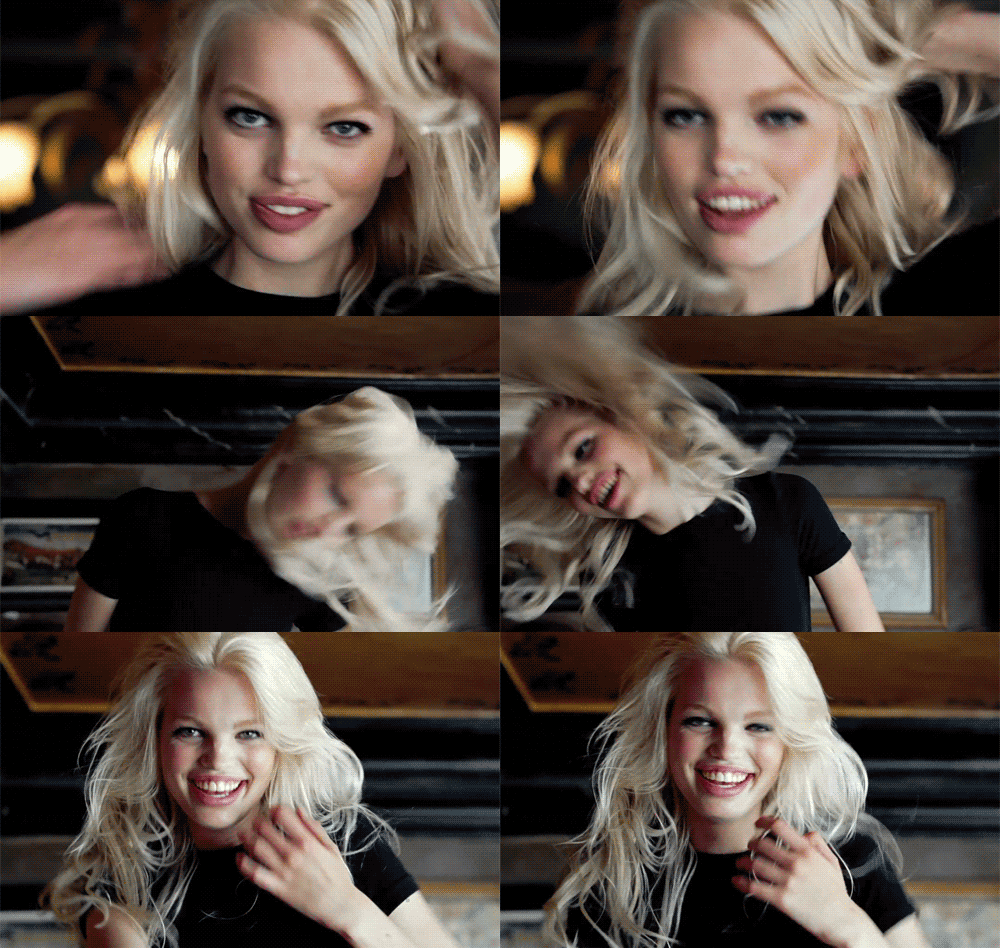
If the now infamous film from Terry Richardson is anything to go by, blonde still acts as a kitemark for sexuality, frivolity and all round good times. It’s a defining feature that tends to be found first on a list of adjectives when describing women with blonde hair. Just the merest flick of a golden tress instantly references goddesses from Venus to Gaga, whilst simultaneously calling to memory every quip and joke ever aimed at the fair haired of the fairer sex.
In September 2011 I started on a spiritual, psychological and experimental hair journey from brunette to blonde. Little did I realise how dramatic the effect on perception would be - both mine and others - and how much I had to learn about the brand of blonde. For a tribe known for its dumbness, there’s a huge amount of complexity beneath the surface.
Sarah Jessica Parker has always maintained that New York City was the fifth character in Sex and the City. And, in Legally Blonde, Elle’s hair was as much a character as any of the film’s stars. To provide subtle cues for Elle’s state of mind and mood, Reese Witherspoon’s hair was reportedly dyed differing shades - a bright yellow blonde for when she’s in love, or an ash blonde for when she’s struggling professionally. Raymond Chandler even went so far as to formally classify the varying ‘types’ of blondes in his literature; “small cute”, “big statuesque”, “soft and willing”, “small perky”, “pale pale with anemia”, “gorgeous showpiece”, and “the blonde who gives you the up-from-under look and smells lovely and shimmers and hangs on your arm and is always very, very tired when you take her home”.
As a chick in two largely male dominated industries - design and tech - I’m not above resorting to fighting dirty with my lady powers if the need arises. I firmly believe that, if people start off thinking you’re stupid, you can only prove them wrong. My blonde hair is now an integral part of my armoury - pretty much guaranteeing that I’m starting conversations from a baseline of zero, with plenty of open space to claim. For women, it’s been said that you can never be too thin, too rich or too blonde - the ultimate triple threat that makes men want them, and other women want to kill them. Even Marilyn Monroe attributed her success to having “blonde hair and a body men liked”. Of course, I’m leaning on huge and demeaning stereotypes for both men and women here, but the more blonde I go the more evidence to support the theory that I’m gathering.
And that’s the point - it’s the stereotype that’s both so interesting and so powerful. As a brand - and by that I mean a recognisable image that represents certain meanings and values - blonde is more or less universally recognised and understood. As a user (hell, let’s take the analogy and run with it), the statements one can make with it are clear and unambiguous. Try as they might, brunettes and redheads have never achieved such refined messaging, or such cut-through in the market.
If the now infamous film from Terry Richardson is anything to go by, blonde still acts as a kitemark for sexuality, frivolity and all round good times. It’s a defining feature that tends to be found first on a list of adjectives when describing women with blonde hair. Just the merest flick of a golden tress instantly references goddesses from Venus to Gaga, whilst simultaneously calling to memory every quip and joke ever aimed at the fair haired of the fairer sex.
In September 2011 I started on a spiritual, psychological and experimental hair journey from brunette to blonde. Little did I realise how dramatic the effect on perception would be - both mine and others - and how much I had to learn about the brand of blonde. For a tribe known for its dumbness, there’s a huge amount of complexity beneath the surface.
Sarah Jessica Parker has always maintained that New York City was the fifth character in Sex and the City. And, in Legally Blonde, Elle’s hair was as much a character as any of the film’s stars. To provide subtle cues for Elle’s state of mind and mood, Reese Witherspoon’s hair was reportedly dyed differing shades - a bright yellow blonde for when she’s in love, or an ash blonde for when she’s struggling professionally. Raymond Chandler even went so far as to formally classify the varying ‘types’ of blondes in his literature; “small cute”, “big statuesque”, “soft and willing”, “small perky”, “pale pale with anemia”, “gorgeous showpiece”, and “the blonde who gives you the up-from-under look and smells lovely and shimmers and hangs on your arm and is always very, very tired when you take her home”.
As a chick in two largely male dominated industries - design and tech - I’m not above resorting to fighting dirty with my lady powers if the need arises. I firmly believe that, if people start off thinking you’re stupid, you can only prove them wrong. My blonde hair is now an integral part of my armoury - pretty much guaranteeing that I’m starting conversations from a baseline of zero, with plenty of open space to claim. For women, it’s been said that you can never be too thin, too rich or too blonde - the ultimate triple threat that makes men want them, and other women want to kill them. Even Marilyn Monroe attributed her success to having “blonde hair and a body men liked”. Of course, I’m leaning on huge and demeaning stereotypes for both men and women here, but the more blonde I go the more evidence to support the theory that I’m gathering.
And that’s the point - it’s the stereotype that’s both so interesting and so powerful. As a brand - and by that I mean a recognisable image that represents certain meanings and values - blonde is more or less universally recognised and understood. As a user (hell, let’s take the analogy and run with it), the statements one can make with it are clear and unambiguous. Try as they might, brunettes and redheads have never achieved such refined messaging, or such cut-through in the market.
The novelist Margaret Atwood observed that, "Blondes are like white mice...They wouldn’t last long in nature. They’re too conspicuous". And with this in mind, my research remains ongoing. In becoming one of them, I'm able to observe their conspicuousness up close while examining the impact of being perceived as dumb, dirty and a fully paid up member of the Too Much Fun club. While blondes may not last long in nature, however, it seems they're doing just fine in the urban jungle of our modern metropolises where sex, success and the mighty brand of blonde sell more than just shampoo. This isn't dumbing down, it's merely blonding up and they're gonna have the last laugh. And not just because they took a while longer to get the joke.
Thanks to JW - a natural blonde - for her collaboration and input. x
Monday, July 16, 2012
Model behaviour
Service is a great barometer for our time. Through economic downturns, technological upturns and corporate u-turns, the changing approach to customer service can be read like a newspaper. I wrote last week on the Moving Brands blog about O2's successful little foray into Twitter-based crisis management, which you can read here. But it was a recent trip to Westfield Stratford - all dolled up for the Olympics - that attuned me to another shift in how brands are are using customer service to cope in today's climate.
"Models protect and project the image of the brand through personal style, providing customer service and maintaining presentation standards" - so runs the job description for sales assistants, known as 'models', at Gilly Hicks. This purveyor of beachwear, 'cute bras' and 'down undies' is the "cheeky", faux Australian cousin of Abercrombie & Fitch. Like A&F and its other (probably backward and almost certainly unsafe around small animals) cousin Hollister, GH caters to buff teens roaming free with their parents' credit cards. Like all stores in the A&F chain, they appeal to their impressionable customers through 00 sizes and stores that are loud, dark and thick with the richly perfumed undertones of consensual rape.
When A&F opened in the UK in 2007, it drew a line in the sand for service design. Harp on all you like over how there was something distinctly 'not cricket' about they way they swanned into Mayfair, stripped to their smalls and started a roaring trade that sex-ed up a once dingy end of Burlington Arcade. Nevertheless, it's impossible to deny that the all-American customer service that came with it was in stark contrast to the stiff pleasantries of Saville Row. It marked a new era for British retail - as people fled online, great customer experiences were the only thing to keep them in-store. Following A&F's lead, many UK retailers woke up to the value of a more touchy-feely sales experience.
In 2012 at Westfield Stratford, however, Gilly Hicks appears to be doing a weak doggie paddle in the swirling tides of socially-driven commerce. I was greeted by a hungry-looking tween, muttering something about 'welcome....beach......cute...something something'. At check out (research, research!) I was handed my receipt and told in a bored monotone "Don't forget to follow Gilly Hicks on Twitter for all the cutest bras and cheekiest tanks.". I've had dental work sold to me with more excitement.
literally cringed with embarrassment when the girl at @GillyHicks danced and said the same thing to all customers. #painful
— David Albon (@DaveShuffles) July 14, 2012
Forging great relationships with customers through social platforms is key for retail brands moving forward. As Mercedes-Benz CEO Steve Cannon said in a recent Fast Company article, "[youth] perception is going to drive perception of the brand... In order to win, you have to know who they are. That means digital, social, and all the things we are doing". And, for the young audience Gilly Hicks is looking to attract, bridging that gap between online and in-store is critical. Only through on-brand customer service and socially-driven messaging can this happen and, right now, their 'models' are seemingly too busy ignoring hunger pangs to start a meaningful conversation for the brand that can continue online.
Labels:
Abercrombie and Fitch,
retail,
service
Wednesday, June 27, 2012
Brand Bedales
It’s not always with the clearest vision that one can look analytically at the formative factors of your lifestyle choices - the culture, brands and rituals that act as the ‘nurture’ overlay to one’s ‘nature’. But having recently watched the final installment of Grayson Perry’s ‘In the best possible taste’, and my ten year reunion occurring this Saturday, I feel enough time has slipped by to look at Bedales.
Most haven’t heard of Bedales School - why would they? It’s just a small, secluded boarding school in the Hampshire countryside. But those that have are often in no doubt of its reputation. From nude mixed bathing in the 1930’s, to underage, drunken threesomes just last year, Bedales has always represented the rebellious underbelly of public schools. A key theme in Grayson’s analysis of the British upper classes was “appropriateness” - something Bedalians (and more importantly Bedalian parents) flaunted their derision of with aplomb. While I remember sitting through many a school assembly being ordered never to consider ourselves “privileged”, I would argue with hindsight that ‘inappropriate privilege’ was the driving force behind everything Bedales did and said.
Bedales attracted two disparate ‘tribes’. In one corner were the deviant aristos - the infamous ‘bad seeds’ unlikely ever to be writ large on their sprawling family trees or immortalised in oil and hung on an ancestral mahogany stairwell. To them, Bedales stood at the furthest end of the shabby chic continuum as a way to reject their aristocratic identity without any of the tiresome day-to-day parenting encouraged by the state education system. Bedales represents the ultimate ‘fuck you’ to the family name by spending the last of the inheritance on preposterous school fees so Tariq could bake artisan bread, roll incredible spliffs and fail all his A levels.
In the other corner were the princes and princesses of the Rock and Roll establishment. The insanely good looking offspring of The Rolling Stones, The Who, The Pogues, The Clash, or those with suggestive surnames like Paxman, Dahl and Day-Lewis. This lot came at it from a different angle - they may have had loads of money but it was all new money - the very worst kind of money. To Rock and Roll parents, Bedales was an easy and fast way to buy into a very specific type of wealthy bohemia. Grayson Perry describes this lifestyle as being “like a play set in the 20s, on lovely misty lawns with decorated swans” and, with its sprawling grounds and moss-covered buildings Bedales offered up just that.
As a brand, Bedales did a fantastic job of appealing hugely to their two target audiences. It had everything a luxury lifestyle brand requires - a compelling heritage, a distinct reputation, an ownable aesthetic and, most importantly, a price tag which made it both aspirational and exclusive. As students, we were the brand's greatest assets and the expectation to fall in line with its values was high. And what great ambassadors we were - directing plays, digging ponds, and indulging in narcotics, eating disorders, alcohol and sex like they were chocolate buttons. Hogwarts on meth.
There’s a line in Absolutely Fabulous where a furious Eddy chastises her daughter for being studious and “normal” with the line “When I think of the schools I sent you to darling, I mean BEDALES for God’s sake!”. The comment implies that being a Bedalian makes you a certain type of person and, to a certain extent both negatively and positively, it does. As a teenager it’s comforting to be totally “on-brand” and “on-message”. After ten years, however, I like to think it’s just a small part of who I am - a streak of rebellious, inappropriate ‘nurture’ running through layer upon layer of nature.
Wednesday, June 13, 2012
Desert Island Digital: Ariane Schick
On this week's Desert Island Digital my castaway is Ariane Schick. Ariane is currently a Masters student at the Royal Academy in London, having studied previously at L'Ecole des Beaux Arts in Paris. She works in a range of mediums - always with a beautifully evocative sense of colour and space. Ariane is bi-lingual, an adventurous traveller, a wonderful crepe maker and one of my oldest friends.
Here's her choices for life on the island.
One tweet upon arrival on the island:
I would tweet a picture of the Twitter bird, whose real life doppleganger has been living undiscovered on the island.
One app:
Shazam. So I could Shazam island sounds in the hope that one day it might recognise a mix between a bird song, the trees rustling and coconuts falling as a song.
One #ff (Follow Forever) on Twitter:
Does Tuttle tweet ?
One album on Spotify:
Wagners Ring Cycle because it's long.
One YouTube video:
One digital luxury:
I'm not sure if this is really digital or a luxury but a loo roll dispenser that doubles as iPod speakers ?
Here's her choices for life on the island.
One tweet upon arrival on the island:
I would tweet a picture of the Twitter bird, whose real life doppleganger has been living undiscovered on the island.
Shazam. So I could Shazam island sounds in the hope that one day it might recognise a mix between a bird song, the trees rustling and coconuts falling as a song.
One #ff (Follow Forever) on Twitter:
Does Tuttle tweet ?
One album on Spotify:
Wagners Ring Cycle because it's long.
One photo:
I don't have it yet but a picture of a very scary animal so I can flash the picture when in danger, until my phone dies that is.
One digital luxury:
I'm not sure if this is really digital or a luxury but a loo roll dispenser that doubles as iPod speakers ?
Subscribe to:
Posts (Atom)